
Why Is It So Hard to Switch Off When Work Is Over?
Why Is It So Hard to Switch Off When Work Is Over?
There are many reasons why, even after closing your laptop, you can't quite switch your mind off from work. Maybe there's an unfinished task, a decision that's still up in the air, or a worry that you didn't do something well enough. Sometimes your thoughts aren't about what happened today at all. They're already moving ahead to everything that needs to get done tomorrow.
Work can stay on our minds for many reasons. You may care deeply about what you do or the people you work with. You may be the sole breadwinner in your family, making the security of your job especially important. Workplace culture can also play a role. A negative environment can leave you carrying tension home, while even a positive environment can leave you feeling mentally and emotionally drained by the demands of the day.
Work stress can also build gradually. You may carry it in your body and mind without fully noticing until you begin to feel overwhelmed or exhausted. And while work-life balance is something we often talk about, achieving it isn't always easy, particularly when some of the pressures come from the workplace itself.
We don't always have control over what happens at work. But we can pay attention to what is within our control and explore small routines that help us transition out of work mode.
Here are five ideas for creating a stronger boundary between work and the rest of your life.
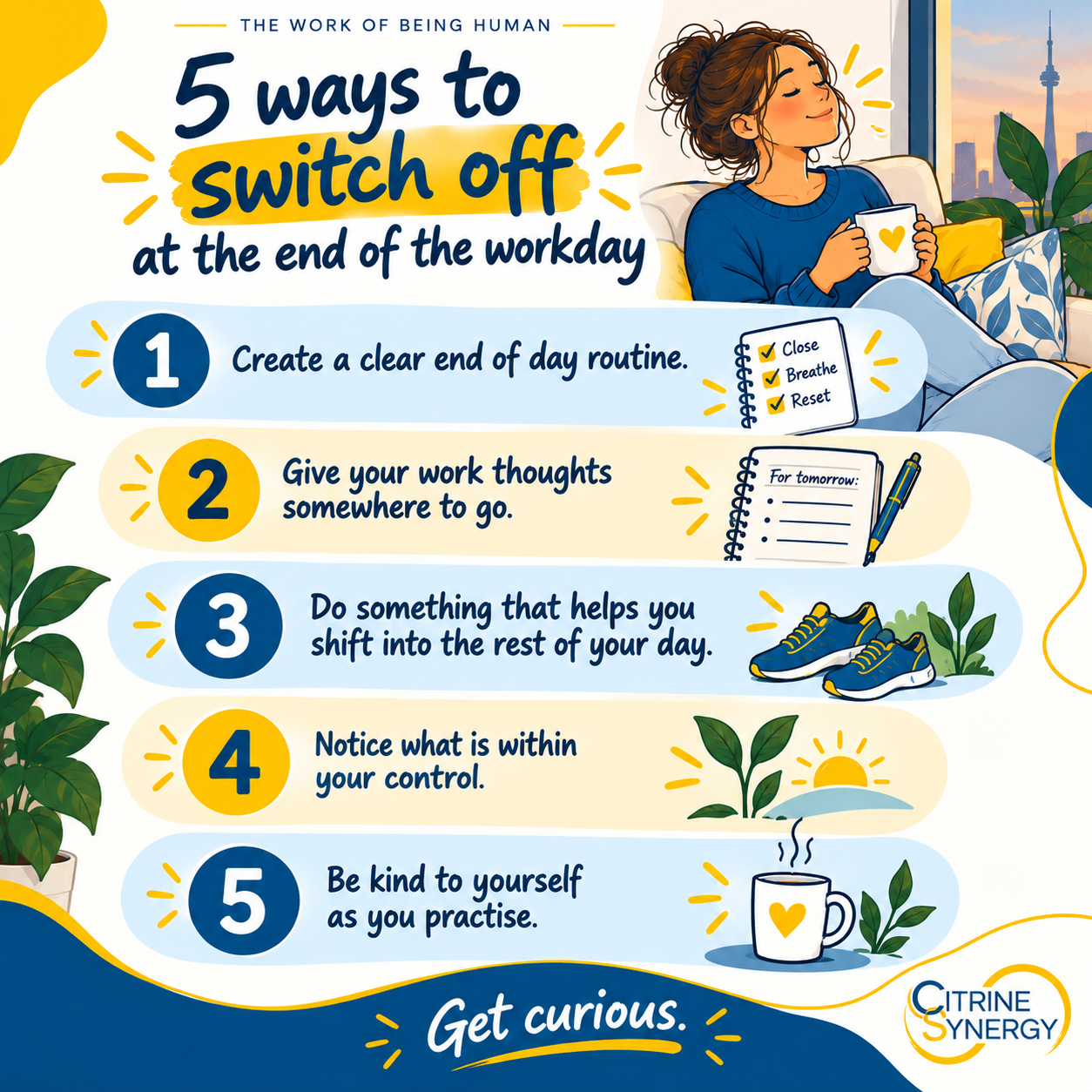
1. Create a clear end-of-day routine
Shutting down your computer can be part of it, but your routine doesn't need to be complicated. You might wash your hands, take a few deep breaths, or write down what needs your attention tomorrow.
The routine will look different for everyone. For me, taking just one minute to breathe deeply can make a difference. It's a small way of reminding myself that the workday is over.
2. Give your work thoughts somewhere to go
When a work-related thought comes up, try acknowledging it rather than immediately getting caught up in it.
You might make a note to revisit it tomorrow, imagine placing it in a folder, or write it in a notebook so you don't feel the need to keep holding it in your mind.
This can be particularly helpful when you're worried about forgetting something important.
3. Do something that helps you shift into the rest of your day
A walk, a stop at your favourite coffee shop, or cooking a meal you enjoy can help create a transition between work and home.
It doesn't need to be elaborate or take much time. The idea is to give yourself a moment to recognize that your workday has ended and the rest of your life is beginning.
4. Notice what is within your control
You may not be able to change your workplace or resolve every uncertainty right away. But you can consider whether there's a boundary you could set, a task you could clarify, or someone you could talk to.
Small steps won't fix every source of workplace stress, but they can help you identify what is within your control and where you might need additional support.
5. Be kind to yourself as you practise
Changing routines and setting boundaries takes time. You may still find yourself thinking about work, even when you're making an effort to switch off.
That doesn't mean you've failed or that your efforts aren't working. Sometimes it takes time to change habits we've developed over many years.
Starting with one small change can be a meaningful first step.
A final thought
There isn't one single reason work follows us home, and there isn't one routine that works for everyone.
Sometimes small habits can help us mark the end of the workday. Other times, ongoing stress may be a sign that we need to look more closely at what's happening in our work environment, the expectations we're carrying, or the support we might need.
Perhaps the starting point isn't asking ourselves why we can't switch off, but getting curious about what's keeping us switched on.
The Work of Being Human
Get curious.